
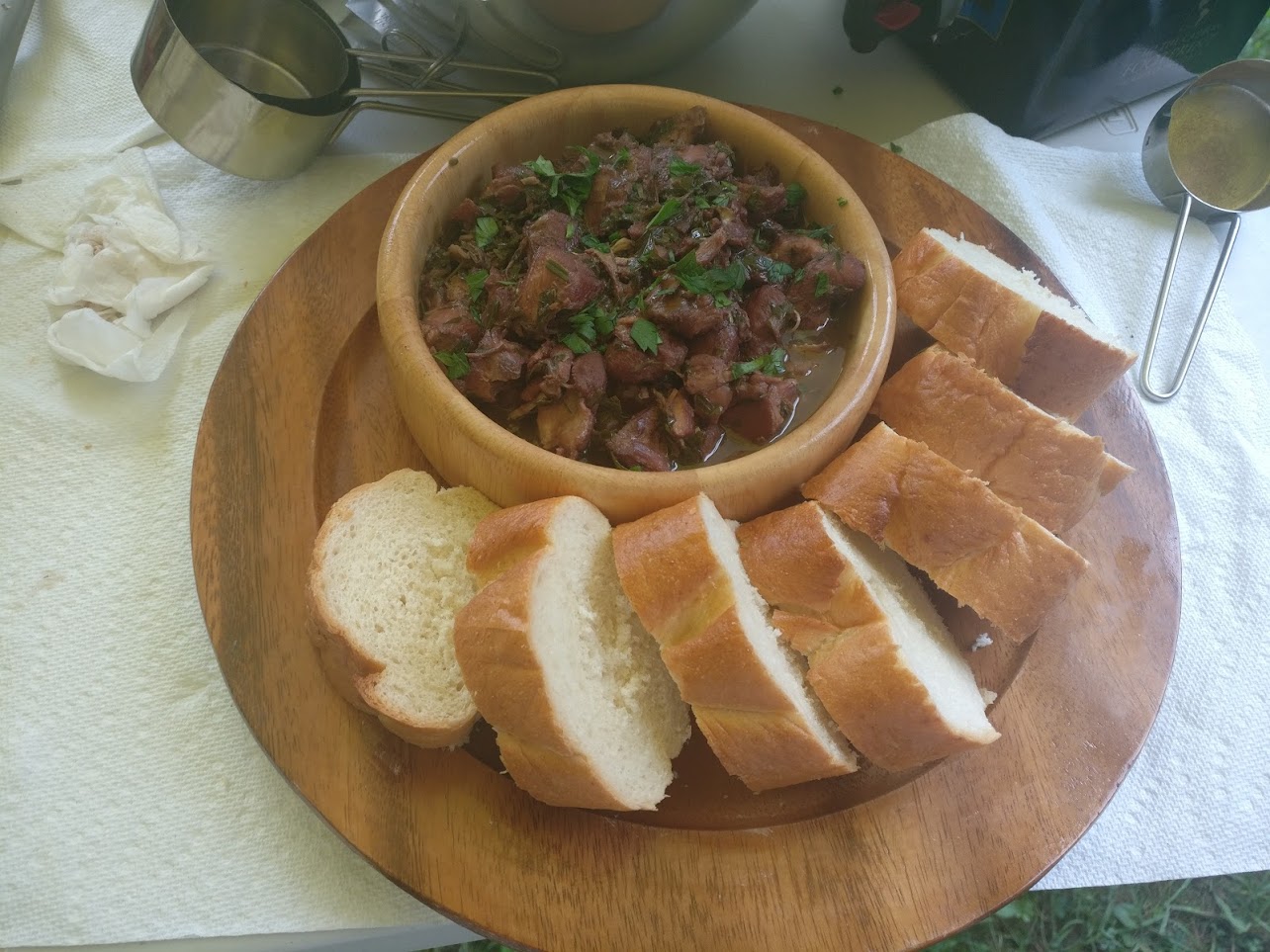
Description
“Bruette” meaning an un-thickened pottage and “Saake” referring to a wine-based sauce, this is the recipe that first got me interested in medieval cooking. It is an aromatic chicken soup of fresh herbs and iconic medieval European spices, tempered with wine and sweetened by chopped dates. This is my redaction after several iterations and refinements.
Source Recipe
Take Capoun, skalde hem, draw hem, smyte hem to gobettys, Waysshe hem, do hem in a potte; þenne caste owt þe potte; waysshe hem a-ȝen on þe potte, & caste þer-to half wyne half Broþe; take Percely, Isope, Waysshe hem, & hew hem smal, & putte on þe potte þer þe Fleysshe is; caste þer-to Clowys, quybibes, Maces, Datys y-tallyd, hol Safroune; do it ouer þe fyre; take Canelle, Gyngere, tempere þin powajes with wyne; caste in-to þe potte Salt þer-to, hele it, & whan it is y-now, serue it forth.
(Harleian MS. 279)
Ingredients
- 2 lbs chicken thighs [1]
- 2 cup chicken stock [2]
- 2 cup red wine
- ½ cup fresh Italian parsley [3]
- 1 Tbsp dried hyssop [4]
- ¼ cup chopped dates
- ½ tsp cinnamon
- ½ tsp ginger
- 1 Tbsp extra wine
- ¼ tsp mace
- ¼ tsp cloves
- ¼ tsp black pepper [5]
- ½ tsp salt
- 10 threads saffron
Directions
De-bone, trim, and cut chicken into 1” pieces [5]. Combine chicken, broth, wine, and dates in a pot and set to boil. Bloom saffron threads in a small bowl with 1 Tbsp of water. Mix cinnamon and ginger in a small bowl with 1-2 Tbsp of wine. Chop parsley finely, set some aside for garnish. Add parsley, hyssop, mace, cloves, pepper, allspice, and saffron bloom to pot. Boil about 30 minutes. Add cinnamon, ginger, and wine mix to pot. Add salt to taste. Cover and simmer another 30 minutes.
Notes
[1] The source recipe clearly calls for whole chicken, however for cost, practicality, and a flavor more appropriate for stews, I prefer to use just chicken thigh meat.
[2] This was a home-made stock of chicken bones, onion, carrot, and turnip.
[3] Both flat/Italian and curly cultivars of parsley were known and grown in the Middle Ages (Our Herb Garden, Parsley History: Early Medicinal Uses). I prefer the former for its stronger flavor, especially in such a heavily spiced dish.
[4] Fresh hyssop is not easy to come by. Dried hyssop loses much of its flavor. However, the use of Italian parsley should help offset the lack of the fresh hyssop’s bitterness.
[5] The original recipe calls for cubeb, “tailed pepper”, which is not widely available. Its flavor is described as being similar to black pepper and allspice (Wikipedia, Piper cubeba). I have used black pepper as a substitution. Allspice could be added as well, but it is a New World spice and its flavor is fairly well covered by the cloves and cinnamon already in the dish.
[6] “Smyte hem to gobbetys” is often translated as separating the meat at the joints (Friedman, p29). For a dish more manageable to serve and to eat, however, I prefer to remove the bones and cut smaller pieces.
Sources
Anderson, John L. and Adams, Adrienne. 1962. A Fifteenth Century Cookry Boke. New York: Charles Scribner’s Sons
Austin, Thomas. Two Fifteenth-Century Cookery Books. Harleian MS. 279…and Harl. MS. 4016. London, Early English Text Society, Oxford Series, No. 91.
Friedman, David and Cook, Elizabeth. 1988, 1990, 1992, 1996, 1998, 2000, 2011. How to Milk an Almond, Stuff an Egg, and Armor a Turnip. Web. http://www.daviddfriedman.com/Medieval/To_Milk_an_Almond.pdf
Hieatt, Constance B. “Sorting through the Titles of Medieval Dishes.” Food in the Middle Ages, A Book of Essays. Ed. Adamson, Melitta Weiss. 1995. New York: Garland Publishing Inc.
Our Herb Garden contributors. “History of Parsley.” Our Herb Garden 2008-2018. Web. http://www.ourherbgarden.com/herb-history/parsley.html
Wikipedia contributors. “Piper cubeba.” Wikipedia, The Free Encyclopedia. Wikipedia, The Free Encyclopedia, 31 Jul. 2018. Web. 31 Aug. 2018. Web. https://en.wikipedia.org/wiki/Piper_cubeba